

Cost
from the series A/12e, 2026, Limited Edition
ABOUT
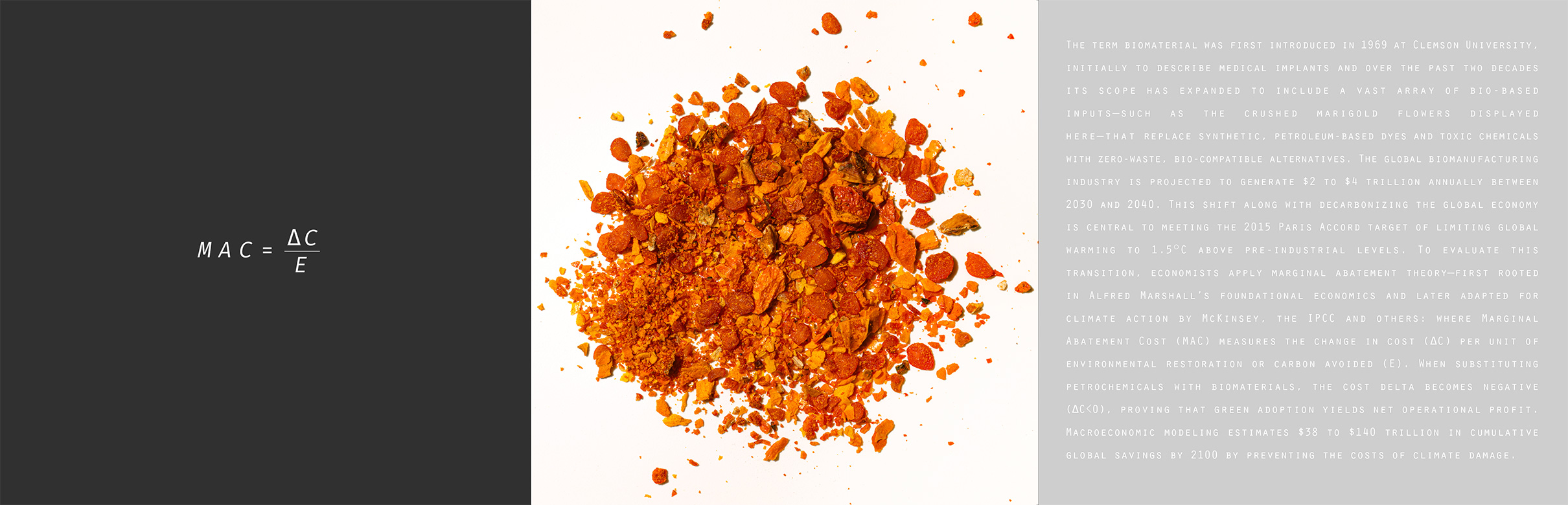
Crushed marigold flowers paired with the marginal abatement equation from the book A/12e (Anthropocene 12 equations) – section 04.
The term biomaterial was first used in 1969 at Clemson University, initially to describe medical implants but over the past two decades the meaning has expanded to include a vast array of bio-based materials such as the crushed marigold flowers displayed here that replace synthetic, petroleum-based dyes and toxic chemicals with zero-waste alternatives. The global biomanufacturing industry is projected to generate $2 to $4 trillion annually between 2030 and 2040. This shift along with decarbonizing the global economy is central to meeting the 2015 Paris Accord target of limiting global warming to 1.5°C above pre-industrial levels. Economists measure the value of this shift using marginal abatement theory, rooted in Alfred Marshall’s foundational economics and later adapted for climate action by McKinsey, the Intergovernmental Panel on Climate Change, and others. The Marginal Abatement Cost (MAC) formula measures the change in cost (ΔC) per unit of environmental restoration or carbon avoided (ΔE). When biomaterials replace petrochemicals, that cost difference drops below zero (ΔC < 0), showing that cleaner production can actually save money. Economic models estimate $38 to $140 trillion in global savings by 2100 simply by avoiding the steep financial toll of cenvironmental damage.