


Tipping Points
from the series A/12e, 2026, Limited Edition
ABOUT
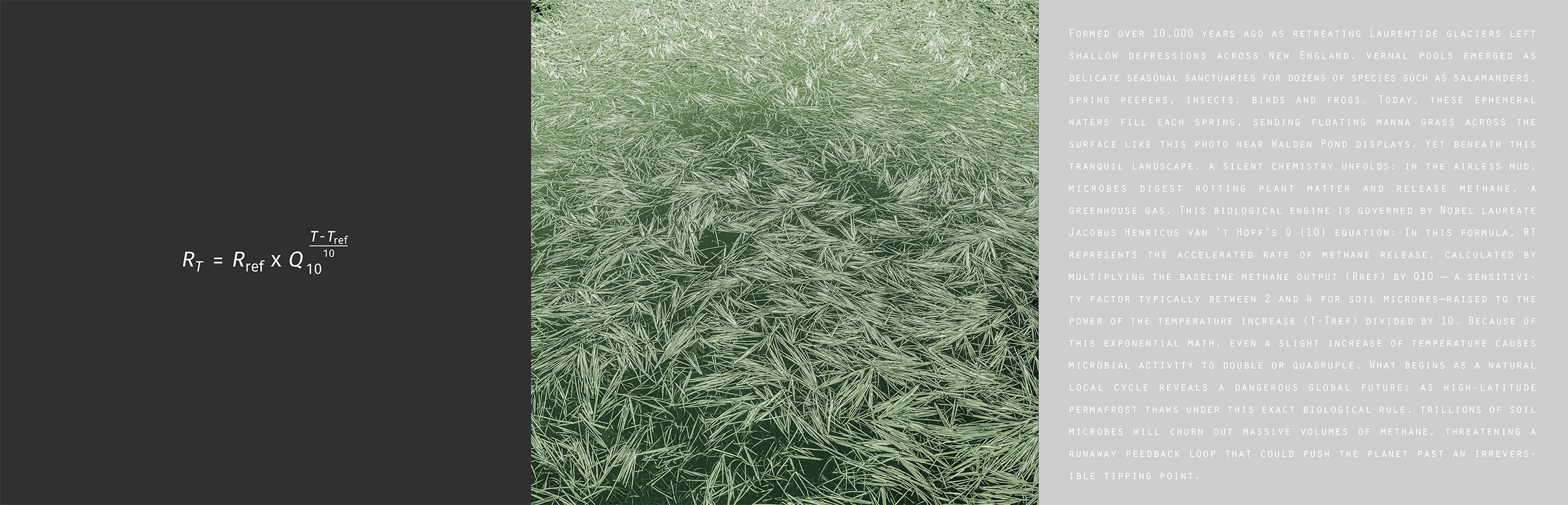
Floating manna grass paired with the Q(10) Temperature Coefficient Formula from the book A/12e (Anthropocene 12 equations) – section 05.
Formed over 10,000 years ago as retreating Laurentide glaciers left shallow depressions across New England vernal pools emerged as seasonal habitat for dozens of species such as salamanders, spring peepers, insects, birds and frogs. Each spring the water level rises from snow melt and rain sending floating manna grass across the surface like this pool in Concord, MA. As the temperature rises in the airless mud below microbes digest rotting plants and release methane a powerful greenhouse gas. The Nobel laureate Jacobus Henricus van ‘t Hoff’s developed the Q(10) equation for this process. In the formula, RT (rate and temperature) represents the accelerated rate that methane is released, calculated by multiplying the methane output (Rref) by Q10 – typically between 2 and 4 for soil microbes, raised to the power of the temperature increase (T-Tref) divided by 10. Because of the exponential nature of rising temperatures and biological processes, even a slight increase of temperature causes microbial activity to surge. As the northern permafrost in regions such as Canada, Scandinavia and Russia thaws, soil microbes are releasing methane which in turn increases temperatures, producing a runaway feedback loop that potentially is unavoidable.
Ecological tipping points like this can be avoided by decreasing fossil fuel use and decarbonizing the global economy. There are also positive tipping points, where clean technologies such as solar energy are now less expensive than fossil fuels creating a self-propelled market shift capable of halting global warming before irreversible feedback loops take over.