

Great Acceleration
from the series Selected Work, 2026, Limited Edition
ABOUT
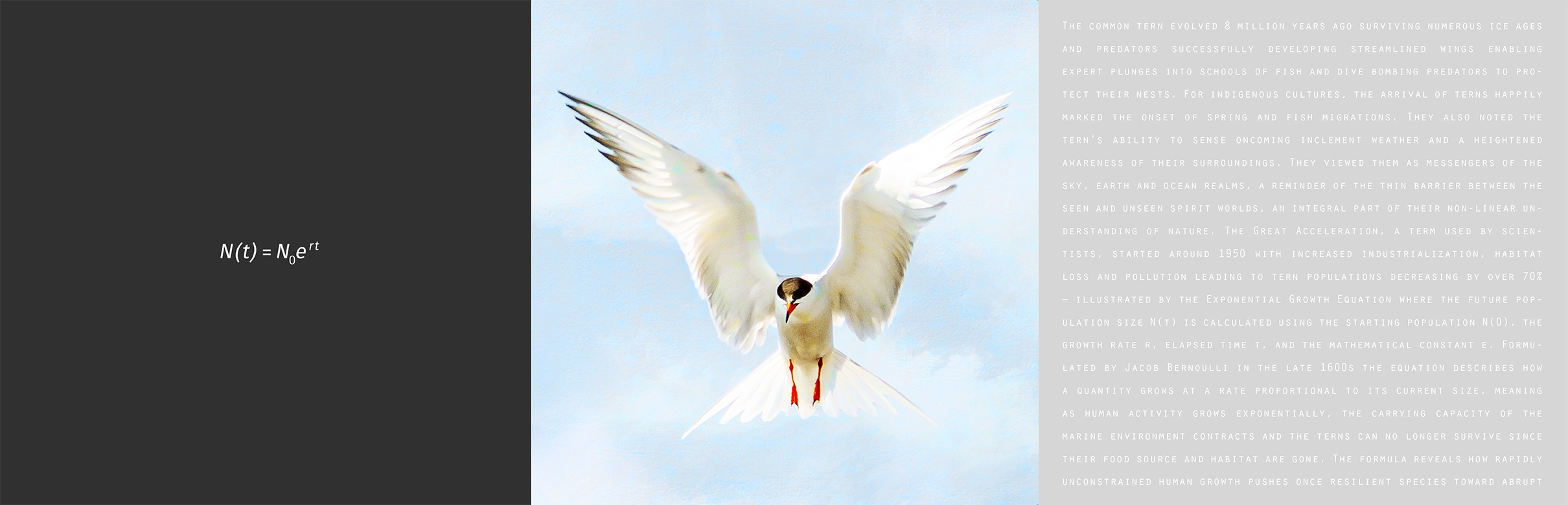
Photo assemblage of a common tern (sterna hirundo) paired with the exponential growth equation from the series A/12e (Anthropocene 12 equations) – section 03.
The common tern evolved 8 million years ago surviving numerous ice ages and predators successfully developing streamlined wings enabling expert plunges into schools of fish and dive bombing predators to protect their nests. For indigenous cultures, the arrival of terns happily marked the onset of spring and fish migrations. They also noted the tern’s ability to sense oncoming inclement weather and a heightened awareness of their surroundings. They viewed them as messengers of the sky, earth and ocean realms, a reminder of the thin barrier between the seen and unseen spirit worlds, an integral part of their non-linear understanding of nature. The Great Acceleration, a term used by scientists, started around 1950 with increased industrialization, habitat loss and pollution leading to tern populations decreasing by over 70%. This trend is illustrated by the Exponential Growth Equation, N(t) = N(0)e^(rt), where future population size N(t) is calculated using the starting population N(0), the growth rate r, elapsed time t, and the mathematical constant e. Formulated by Jacob Bernoulli in the late 1600s the equation describes how a quantity grows at a rate proportional to its current size, meaning as human activity grows exponentially, the carrying capacity of the marine environment contracts and the terns can no longer survive since their food source and habitat are gone. The formula shows how fast unchecked human expansion can push even adaptable species toward sudden collapse.
While regional population crashes are happening, preservation initiatives have shown high recovery rates. Common terns are listed as ‘Least Concern’ by the IUCN (International Union for Conservation of Nature) due to a significant global population, increased conservation initiatives and historical adaptability. However, if marine ecosystems continue to degrade even their long history of adaptability will not be enough to save them.