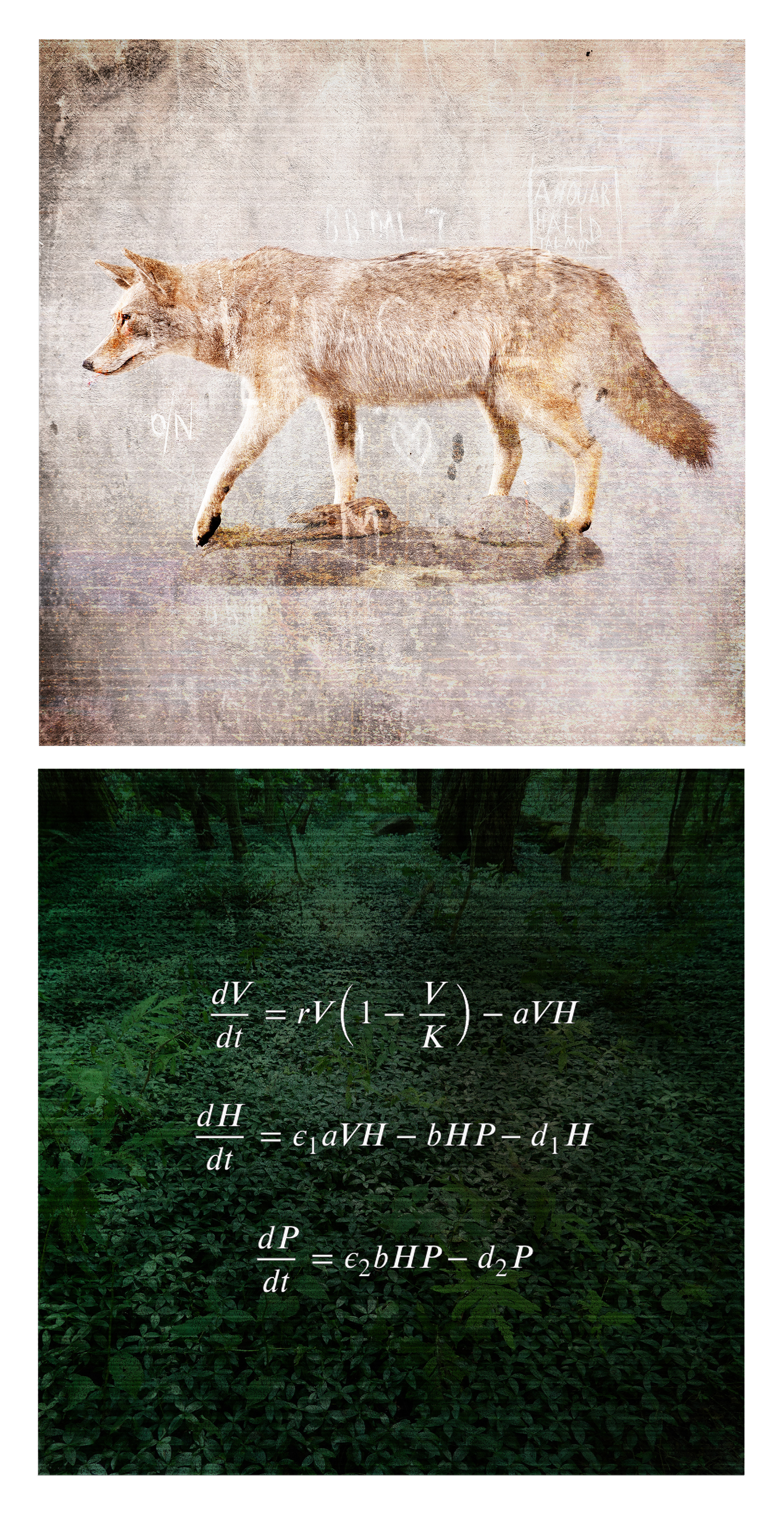

Wolf I
from the series Selected Work, Limited Edition
ABOUT
From a new series pairing wildlife and related equations. This piece pairs the eastern wolf (photographed at the RISD Nature Lab) with a formula showing what happens when a top predator disappears.
Since wolves are locally extinct, the deer population has increased exponentially. This reduces habitat for small mammals, plants, and birds. It also increases tick-borne diseases and invasive plants, dramatically changing forest ecosystems.
Management initiatives are currently tackling this issue through increased deer hunting, ecological fencing, slash walls, contraceptive vaccines, and sterilization. At the same time, other deer predators are increasing—most notably eastern coyotes, the “Coywolf” (coyote-wolf hybrid), and black bears.
The Math: The featured equation is the Vegetation–Herbivore–Predator ecological model. It maps what happens when predator or herbivore populations change, and the cascading effects on native vegetation. It is an extension of the classic Lotka–Volterra predator-prey model that incorporates logistic growth at the bottom level and tracks energy/mass transfer across three levels of a food chain.
Variable Definitions
V(t): Population density of Vegetation (Plants / Producers) at time t.
H(t): Population density of Herbivores (Primary Consumers) at time t.
P(t): Population density of Predators (Secondary Consumers / Carnivores) at time t.
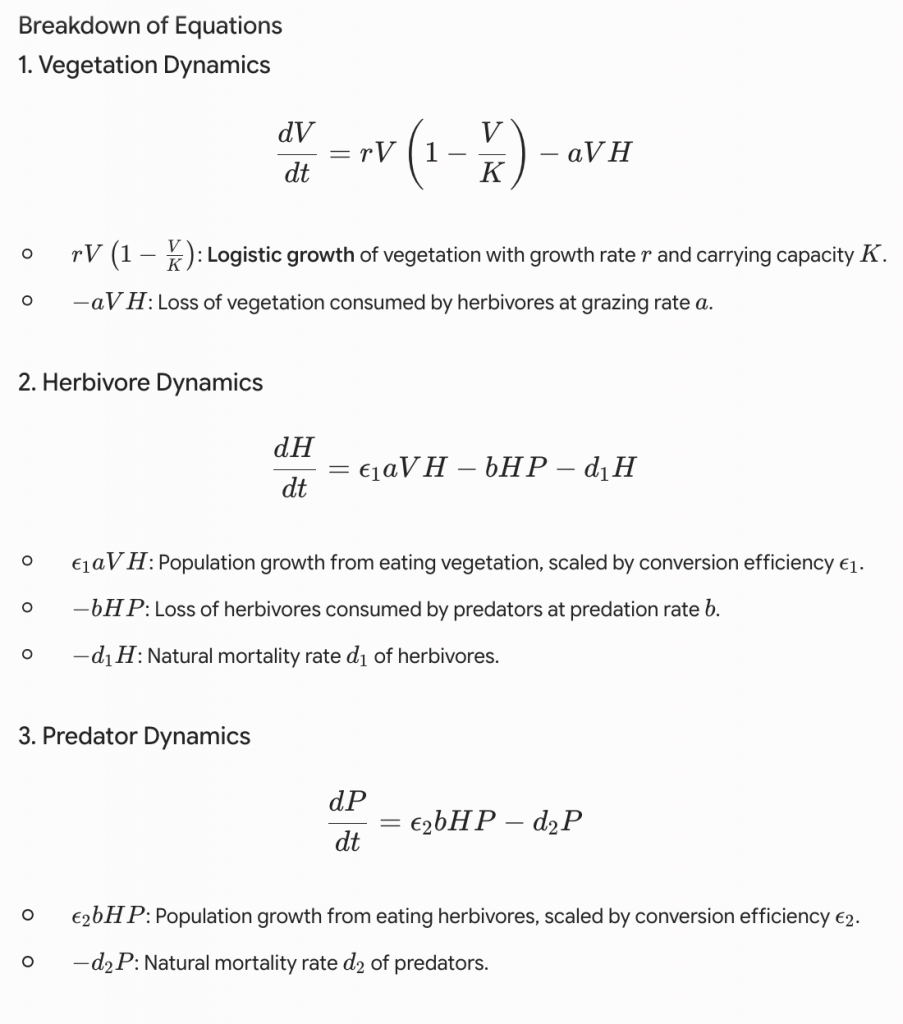
See more about Lotka–Volterra Equations, which outlines the framework the above math equations are derived from.
This image is part of a new series called A/12v (Anthropocene / 12 Views) exploring contemporary perceptions of ecosystems during the Anthropocene.
Many thanks to the RISD Nature Lab for providing this resource.